The specification, in the open.
This page is the working technical baseline of the HEX container standard. Numbers, interfaces and build stages, written down so they can be checked, cited and built against. Everything here is the current state and moves as the design matures.
Three sizes, one hexagon.
A hexagonal prism of six side panels with a floor and a lid, fully segmented so it can be built in a university hall and transported disassembled. The shape is chosen for one reason. On a surface you cannot leave gaps, and of all shapes only the triangle and the hexagon tile cleanly. The hexagon gives the most volume for the least material and grows in every direction.
| Parameter | HEX S | HEX M | HEX L |
|---|---|---|---|
| Vertex to vertex | 2.00 m | 4.00 m | 8.00 m |
| Flat to flat | 1.73 m | 3.46 m | 6.93 m |
| Edge length | 1.00 m | 2.00 m | 4.00 m |
| Cross section | 2.60 m² | 10.39 m² | 41.57 m² |
| Height, working value | 2.00 m | 2.50 m | 3.00 m |
| Internal volume | 5.20 m³ | 25.98 m³ | 124.71 m³ |
| Status | Flying first | Scale derivative | Outlook |
Heights are an early prototyping working value and are explicitly preliminary. Volumes follow from them and move with them. HEX S is the unit under construction, HEX M and HEX L are scale derivatives of the same geometry.
One adapter carries everything.
Coupling happens over one flat hexagonal face that works as a male and female adapter. That single face routes every system through itself. There are no six separate ports and no coupling nodes, because every extra port is another seal, another failure mode and another thing two organisations have to agree on.
The container we build today has exactly one opening, and that opening is what later becomes the adapter. The remaining five sides stay closed. Growing a cluster means adding adapters only on the faces that need to connect, up to three on selected sides. The welded corner joints of the prism are structural and nothing else. They do not couple, lift or tile.
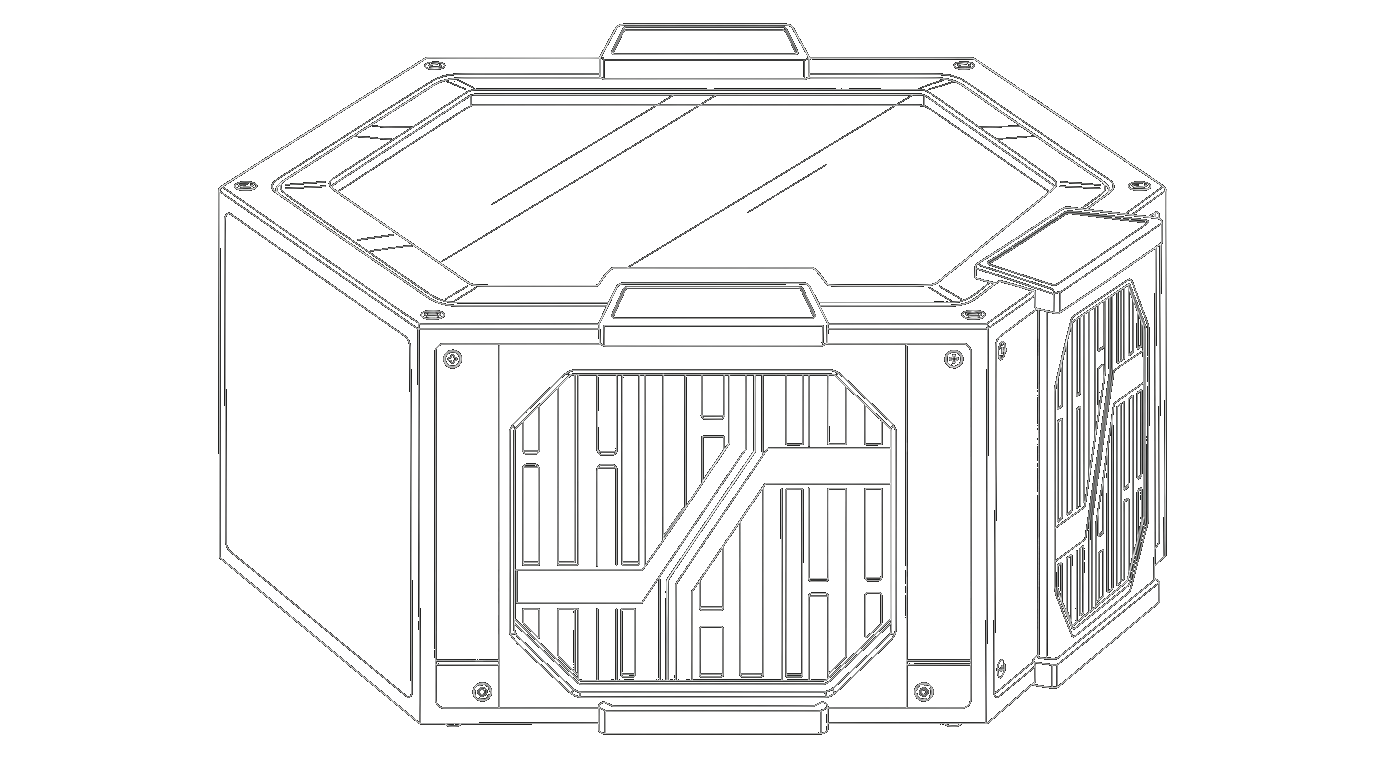
What the adapter has to do is public. How it is built is not published in detail while the design is being qualified. Functions and requirements yes, construction no.
One face, three escalating doors.
The same adapter face carries three levels of opening. Only the first one is what we build now. The other two are designed for from the start so that nothing has to be redrawn later, and they are options rather than promises.
Cargo hatch
A wide opening for regolith, equipment and supplies, working like a garage door. No pressure seal is needed, which is exactly why it ships first. The face already carries the structural latch, self alignment and the power and data passthrough.
Pressurised coupling door
A pressure tight passage between two units so crew and cargo move in a sealed environment without a suit. Through the same coupling run power, data, thermal and breathing air.
Airlock
The boundary between inside and surface. Crew in and out, dust mitigation, emergency isolation. This is the step where a sealed container becomes a habitat, and it is shown as a possibility of the standard, not as a product.
Two tracks, one geometry.
Hardware moves up a material ladder rather than jumping to flight metal. A ground track runs in parallel on steel, because for analog stations, testbeds and exhibition units mass is irrelevant and robustness, cost and speed are not. The steel line pulls first real metal forward by roughly a year. Aviation aluminium stays the separate flight track.
Steel, from 2027
Analog, testbed and demonstration artifacts. Weldable, cheap, fast and honest to handle. Every ground deployment produces handling heritage that a drawing cannot.
PLA, then PETG, then aluminium
Geometry and interface verified at small scale and low cost before any flight grade part is cut.
Aviation aluminium
The qualified flight structure, separate from the ground line and following its own qualification path.
The wall does the work, not the hull alone.
Published analog and habitat research points at one result. Radiation and thermal survival come from the layered wall, and regolith on its own is not enough. The working stack we design against is this.
The structural skin that carries pressure and load.
Local mass for radiation shielding, without the secondary particle problem of dense metals.
The dominant thermal factor. It holds a workable inside temperature against 211 K outside.
The specification is free. Compatibility is the product.
Open standards get adopted. Protected ones get ignored.
CubeSat is the proof. A standard only becomes a standard when anyone can build against it without asking permission, so HEX is published rather than sold. We do not earn on the norm itself.
Thermal and structural values follow published work on curved and layered habitat walls by Mandal, Acceleron Aerospace Journal 2026. The comparison there is curved against cylindrical, while the HEX shape is faceted and sits between the two, so the direction holds and absolute values are being recomputed for our geometry. Closed loop life support, resource use on site and international cooperation are named in the analog literature as the real bottlenecks, not the material.
Build against it.
Put a payload in the configurator and we come back with a real answer, or write to us if your question is about the specification itself.
Open the configurator →